
|
Raw Feeding is also known as BARF (Bones And Raw Food or Biologically
Appropriate Raw Food) or Species Appropriate Raw Feeding. Tanyati
Boxers is a completely natural kennel. We do not feed any commercial
food to our Boxers, and bring all our litters up naturally, feeding
only the best raw food we can get. We believe wholeheartedly in
this method of feeding and give preference to people who are willing
to continue feeding their puppies in this way. BARF feeding is practised
all over the world, and the benefits of feeding your dogs this way
are numerous.
I
have attempted to give a very basic outline of this method of feeding
below. There are a number of websites that go into far more detail,
and I urge all people wanting to feed their dogs in the way nature
intended to visit these websites and learn as much as you can about
raw feeding.
Very
basically, the diet is based on the fact that the dog comes from
the wolf, which is a wild carnivore. As such, they eat the animals
that they kill. This means that everything a wolf eats is raw, and
bones form a very important part of their diet. Their gut and intestines
are designed to cope with raw bones, bacteria and other such things
that we would turn our noses up at. The dog is really not so different
from the wolf and even though he has been domesticated, his gut
has really not changed that much over the centuries. A chapter in
the publication The Genetics of the Dog (ed A Ruvinsky & J Samson,
Robert Wayne at UCLA and Carles Vila at the University of Uppsala,
Sweden), confirms the wolf origin of the dog and that the difference
between the DNA of dogs and wolves is only 2%, and with the Coyote,
their nearest relative 7½ %.
Commercial food became BIG business a few years ago and a large
amount of money has been spent by these multi-million dollar companies
on 'educating' the dog-owning public about the necessity of feeding
a commercial food. What does not make sense to me (and most other
'raw feeders' the world over) is that the basis of most of the commercial
foods today is grain, rice or corn. These are all ALIEN products
that a wild carnivore would never eat. Not only that, but they cook
the food. I don't know about you, but I've never seen a wolf with
a stove!
So, seeing as our domestic dogs can't go around killing their own
prey (well, some do, but they're not popular!) we, their owners,
fulfill that requirement by providing a diet as close to a raw natural
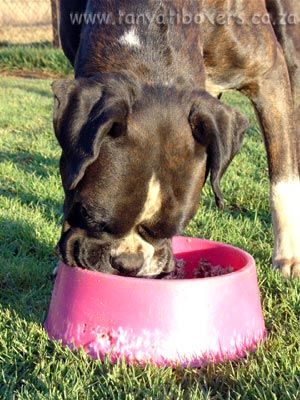
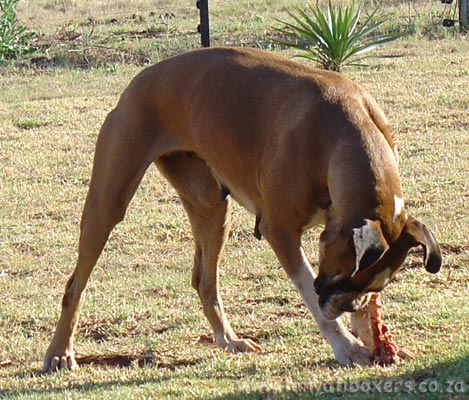
diet as possible. Everything I mention below is fed raw!
• 60% Raw Meaty Bones (meat with bone – chicken heads,
backs, necks etc.)
• 35% Muscle Meat (meat without bones)
• 5% Organ Meat (liver, kidney, lungs, etc.)
The meat and bone is fed in a ratio of 50% meat to 50% bone. I use
chicken heads minced up. This means that the brain is included,
which is an excellent source of nutrition. You can use chicken backs.
Chicken wings are also excellent, but a bit expensive here in South
Africa.

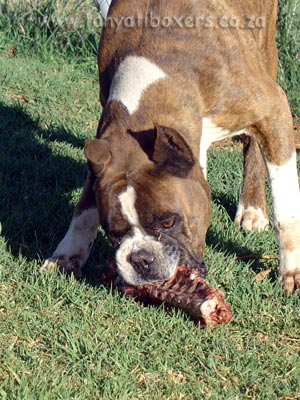
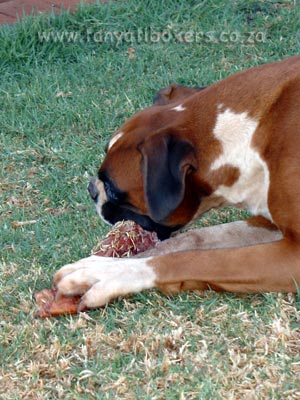
Inca aged 9 1/2 years tucking into a warthog backbone!
If
wild carnivores are observed on a kill, the first thing that they
devour is the stomach, intestines and their contents. For this reason
I feed green, or dirty, tripe (afval). Dirty tripe contains digestive
enzymes from the herbivore (cow) as well as some stomach contents
and this imitates the stomach and contents of the prey animal. Dirty
tripe is fed once a week, as a meal on its own.
Ox
heart is also fed once a week as a meal on its own. You can also
add liver and kidney to the ox heart, but in much smaller quantities,
with half as much kidney as liver.
A
puppy would need the chicken backs or wings minced at first, but
by the age of 4 – 5 months will be able to eat them whole
– although I always cut the chicken backs in half, even for
the big dogs. There’s no need to worry about a chicken bone
getting stuck in their throat! That’s only applicable to COOKED
bones and since this diet is RAW there’s no problem! The cooking
process changes the molecular structure of a bone and renders it
brittle, which is where it will splinter and get caught in the dog’s
throat. Raw chicken bones are actually pliable and fairly soft,
and unlikely to get caught. You can do your own experiment with
this by taking 2 chicken wings, cooking one and leaving one raw.
Then snap the bones in half and see the difference for yourself.

A
chicken carcass once a week is also an excellent meal and will be
enjoyed by your dog more than anything! Chicken necks are great
for a treat but there is not enough bone and too much cartilage
on a neck to form a main part of the diet.
As
with all meals, a puppy should be observed when eating so that you
can ensure that there are no problems experienced with his food.
One
of the main initial sources of information on raw feeding is a Dr
Billinghurst, who is a vet based in Australia. He has called this
way of feeding BARF which stands for Bones And Raw Food, or Biologically
Appropriate Raw Food, depending on where you read up on BARF. Dr
Billinghurst has written 3 books on the subject and they are a wealth
of information to anyone interested in investigating this method
of feeding. My dogs’ diet differs slightly from him in the
ratios and I do not feed as much vegetable matter as he advocates
– using just green tripe as my vegetable component.
I
also add Keeper’s Mix (from Dorwest Herbs – www.dorwest.com)
to my dogs’ food every day, as well as Salmon Oil capsules
every morning. Vitamin E is also added as this must be done if oils
are added to the diet. In addition, I also include Apple Cider Vinegar
(ACV) capsules once a day. ACV contains more than 30 important nutrients,
12 minerals, over 6 vitamins, essential acids and several enzymes.
Moreover, it has a large dose of pectin for a healthy heart, and
thus, healthy as a whole. It is antibacterial and anti-fungal and
gives the immune system a good boost. As a high potassium electrolyte
balancer, it remineralizes the body and helps normalize the blood’s
alkaline acid balance.
ACV
is proving most beneficial to people or animals with arthritis because
it breaks down calcium deposits in the joints while remineralizing
the bones. It has proven to be equally beneficial to dogs with hip
dysplasia.
ACV is a good remedy for food poisoning and helpful in digestive
upsets. It is also effective for urinary tract infections and it
lowers high blood pressure. In fact, daily use of ACV eliminates
tear stains around the eyes and nose of pets with white or light-colored
fur. For those on diuretics, it is helpful in replacing potassium
depletion.
Useful
links:
Info
on Apple Cider Vinegar: http://www.preciouspets.org/newsletters/articles/apple-cider-vinegar.htm
Top 50 most frequently asked BARF questions: http://www.njboxers.com/faqs.htm
Dr Billinghurst’s website: http://www.barfaustralia.com
|